Kim • Published 04 2026 Jun
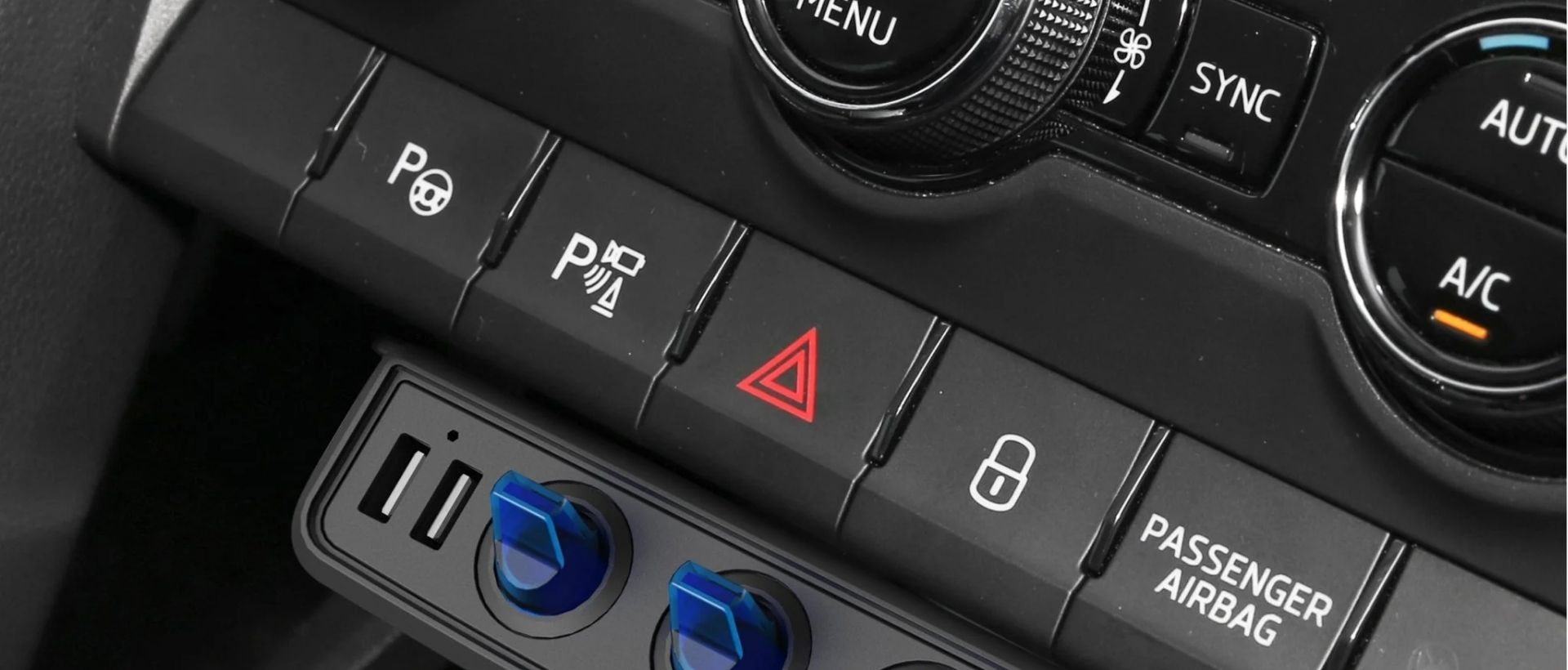
An automotive switch can be considered as one of the most common components that is used within a car; however, it is commonly ignored. It may be small, but it has a big role; these switches connect the user with various components such as windows, headlights, air conditioner, and engine control. In this blog post, various types of automotive switches will be discussed.
The automotive switch is an electrical component used by drivers or passengers to control various components within vehicles by turning the power on and off. Examples of such tasks include pressing the window button, turning on the headlights, and regulating the air conditioning system.
Most of these are housed in an automobile switch panel to make it simple for the driver to activate or disable functions such as power windows, mirrors, seat heaters, and climate controls. These automobile switches are designed to withstand numerous operations, heat, and vibrations.
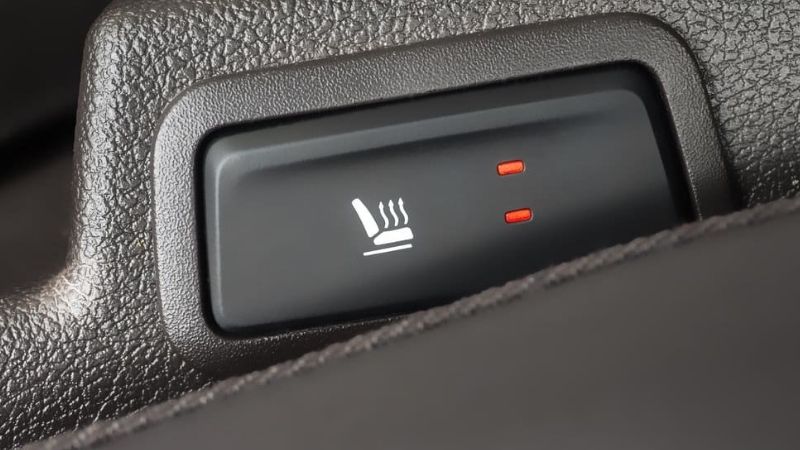
The automotive switch regulates the connection of the power supply to the targeted system within the automobile. When the switch is triggered, it closes or opens the circuit, allowing or blocking the flow of the current. Proper automotive switch wiring is necessary since wrong wiring may lead to performance or safety issues.
Mechanical switches rely on physical switching. By pressing, rotating, or toggling the actuator, the internal contacts are engaged/disengaged, thereby controlling the flow of electricity in the circuit.
Additionally, automotive switch labels are necessary to make them easy for identification by drivers, as well as to reduce operational mistakes while driving.
Unlike mechanical switches that rely on physical contacts, electronic switches have semiconductor parts. Such parts improve accuracy, speed, and durability as a result of the minimized physical wear.
Smart switches are the latest type of switches. They integrate electronic functioning with touch screens, voice, and sensor interfaces.
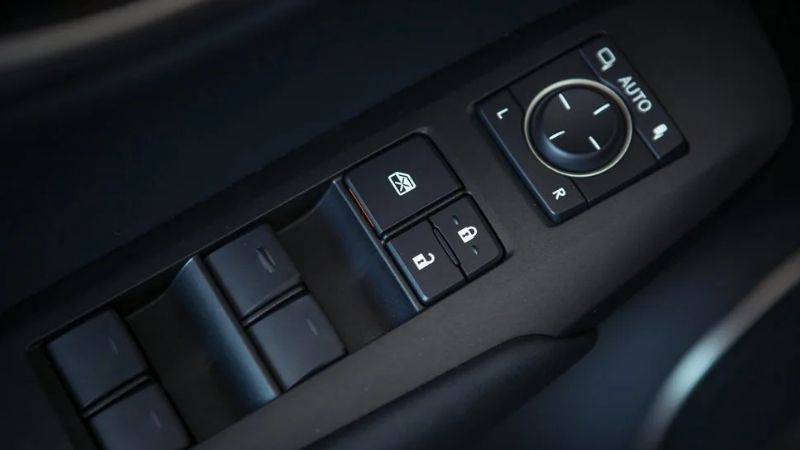
Now, let’s have a look at the basic functions of an automotive switch.
Safety is one of the most critical aspects of an automotive switch. Drivers frequently use switches to regulate headlights, danger lights, brakes, and windshield wipers.
Research indicates that a two-second delay in driver response significantly increases the probability of an accident. Therefore, the position and speed of the switch response are crucial in vehicle design. A good switch provides quick reaction, dependable functioning, and clear feedback, improving road safety and reducing driver distractions.
The automotive switch enables us to have control over numerous vehicle systems. It allows us to start an engine, lock/unlock doors, adjust mirrors, position seats, use infotainment systems, and regulate climatic conditions.
Modern automobiles come equipped with over 50 controls on the dashboard alone and over 100 switches in the entire vehicle. With poor designs for such switches, controlling these systems would be difficult and tiresome for drivers.
Proper automotive switch designs improve the efficiency and comfort levels of users. Controls must be placed such that the user does not have to strain and look away from the road to access and operate them.
Improperly positioned controls make long journeys tiring for drivers. In automotive interior engineering, we conduct tests to establish the optimal way to locate controls at different stages of vehicle development.
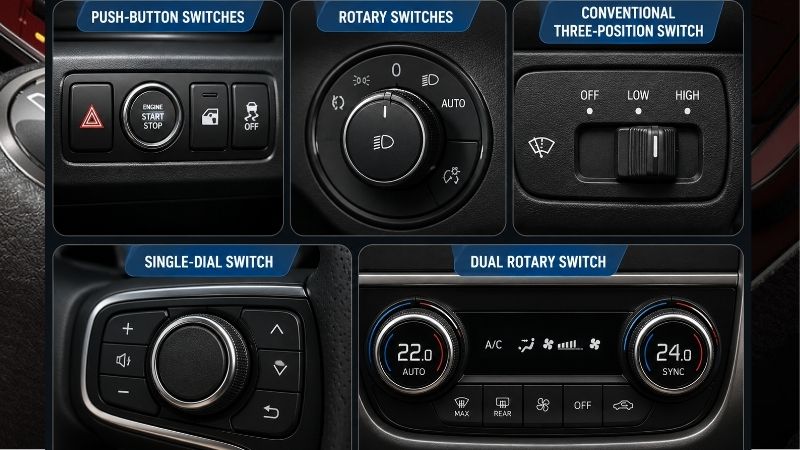
Here are five automotive switch types that are currently used most widely in modern vehicles:
Push-button switches require a simple pressing movement. We use push-button switches all the time to regulate danger lights, engine start and stop, power windows and doors, and the electronic stability program. The engine start button, for example, should respond within a few milliseconds to correctly operate the vehicle.
These devices are rather simple, quick, and inexpensive. That is why we value them for their quick response time, simple installation, and dependable operation.
Rotary switches operate by turning a knob to select different functions. It is convenient since it allows for multiple-position settings, which is why this type of switch is used for a variety of purposes, including headlamp adjustment, airflow management of the air conditioning system, temperature control, and seat heating.
For example, a 6-speed seat heating rotary switch allows the driver to choose one of six heating levels for maximum comfort. Rotary switches provide superb tactile feedback. There is a strong click sensation at each setting, so you do not need to glance at them while operating. This function improves convenience, precision, and driver safety.
The switch may control devices in three distinct positions. An example may be OFF-LOW-HIGH or AUTO-OFF-ON. These switches might be used to control wipers, the speed of the cooling fan, and even the lights. We frequently find this in wiper switches with low, high, and intermittent modes.
Single dial switches work with one rotary knob that allows navigating between various items. Such switches are widely used in multifunction steering wheels for changing volumes, navigating through menus, or switching screens on the instrument panel. Such switches are popular in SUVS like the Toyota Prado.
Dual rotary switches feature two independent rotary switches in one package. We use them for dual-zone automatic air conditioning systems, in which both the driver and passenger can choose their own temperature settings. In this case, the left-side rotary switch controls the left zone, whereas the right-side rotary switch controls the right zone.
It provides a clear functional division and good visual organization. This increases efficiency and clarity on the control panel. We prefer using dual rotary switches if we have more than one control working independently on a restricted control panel area.
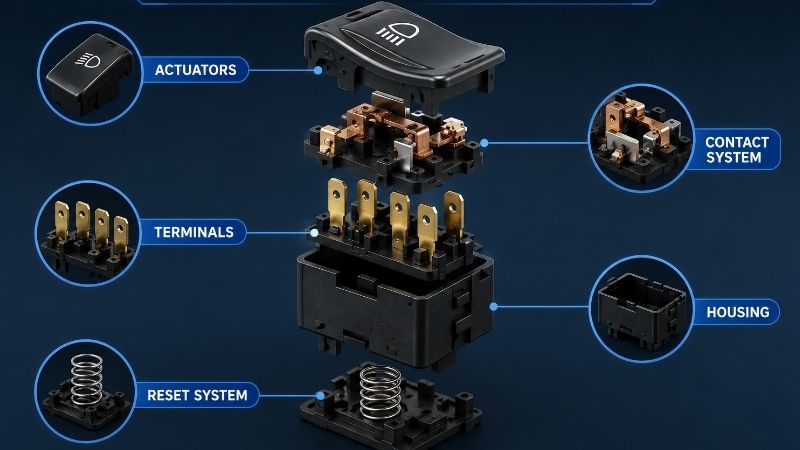
We design automotive switches that have five components to ensure effective switching performance.
Actuators: This is the component that the user interacts with during switching; it may be in the form of buttons, knobs, rocking levers, or toggles. The actuator transmits the switching signal to the switch component.
Contact System: It controls the flow of current through an electrical circuit by bringing movable and stationary contacts together or separating them.
Terminals: The terminals facilitate the connection between the switch mechanism and the vehicle’s electrical system.
Housing: This is the cover of the entire switch assembly, protecting it against physical shocks, vibrations, moisture, and dust particles.
Reset System: This component facilitates the resetting of the switch to its neutral position. Springs are the typical reset mechanisms.
No, an automotive sensor isn’t the same thing as an automotive switch. Switches are used to control a function, while sensors are there to monitor what’s going on.
The switch is an input device that allows you to toggle on or turn off a system or part of it. For example, activating the brake pedal switch will immediately activate the brake light indicator.
The sensor is a device that detects temperature, pressure, speed, position, voltage, or fluid level and transmits the data to the engine control unit (ECU).
Sensors are becoming increasingly important in electric vehicles (EVs). Battery temperature, voltage, current, and motor position sensors are used to protect the high-voltage circuit and control battery functioning.
Based on my observations, switch failures often result in the entire loss of the relevant feature, such as the inability to charge or use power windows, whereas sensor failures typically result in warning lights, reduced driving range, ineffective charging, or battery protection.
When choosing an automotive switch, we consider three key factors: quality, dependability, and affordability. The price is crucial since low-end products break sooner and cost more to repair and maintain.
We never disregard technical factors, such as contact material, housing strength, dust and moisture protection, and standards. It is required to maintain performance and longevity.
In practice, inadequate switches have been linked to poor contact, unreliable signaling, overheating, and failure. As a result, employing a properly constructed switch will improve the product’s longevity and increase consumer confidence.
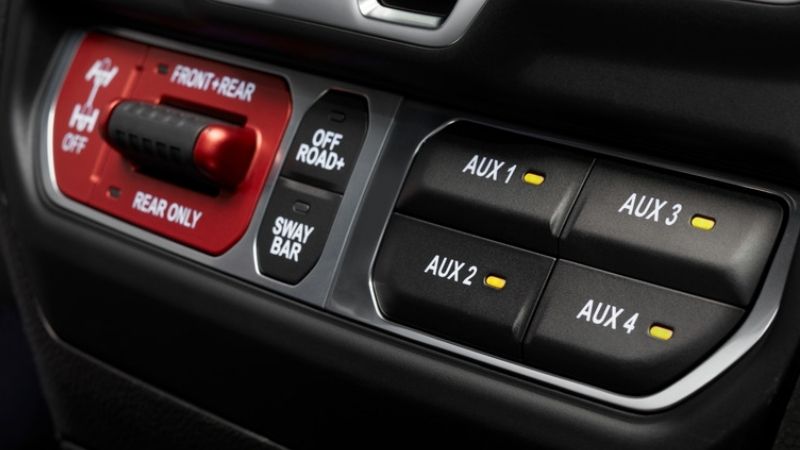
Automotive switches evolve in tandem with manufacturing requirements, usability, and space minimization within automobiles. This is consistent with the development trends in automotive CNC machining.
Capacitive touch technology is being used to replace traditional switches with touch surfaces. We see a more elegant interface, but higher standards for finish and housing.
Haptic feedback is becoming the industry standard. It creates a “click sensation” without motion, thus making users feel confident while driving.
Voice control reduces manual switch usage. This causes a shift in machining methods towards producing strong housings and mount points.
Integrated switches combine numerous functions into a single device, which simplifies the instrument panel but increases precision demands during assembly.
MEMS switches are highly advanced and miniaturized systems that require highly precise support and CNC-machined components.
In my opinion, automotive switches not only serve the function of controls, but they are essential connections between the driver and the vehicle itself. Our designs affect not only comfort but also the safety and reliability of vehicles. With the increasing complexity of vehicles, we prioritize precision in design, reliability, and usability of our products.
At DEK Automotive, we constantly develop new designs using advanced materials to meet evolving automotive demands. Contact us for a detailed quotation for your next project.
Kim oversees engineering operations, including complex CNC programming, DFM reviews, and solving challenges associated with high-precision automotive components. He specializes in strict tolerance control and multi-axis machining of complex geometries essential for powertrain modules, suspension systems, and ADAS sensor housings. Outside of work, he enjoys the precision and strategy of playing snooker.
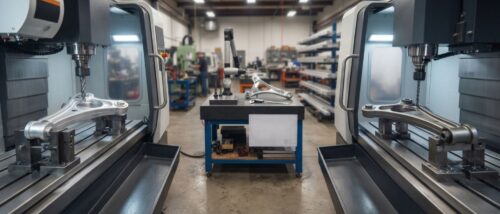

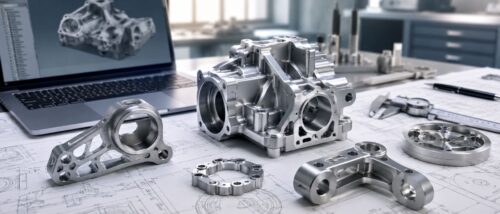
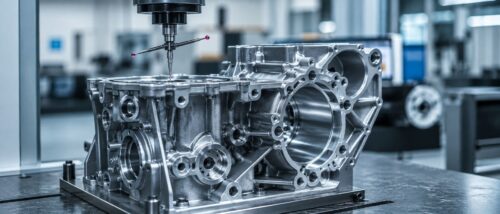

We integrate advanced machining, specialized materials, and surface finishing to deliver mission-critical parts that meet every rigorous automotive standard.
Fill out the form below and our team will get back to you promptly with a personalized quote tailored to your needs.