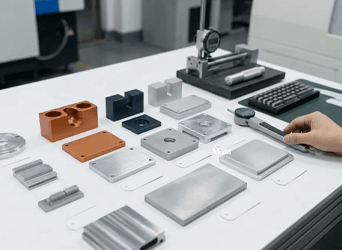
A liquid cold plate takes heat from a device mounted on its face and hands it to a coolant, which carries it to a radiator or chiller. How the plate is built decides how much heat flux it can handle, how much pressure drop the pump must overcome, what each plate costs and where it could leak.
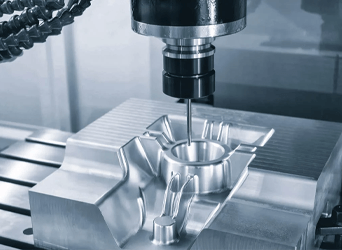
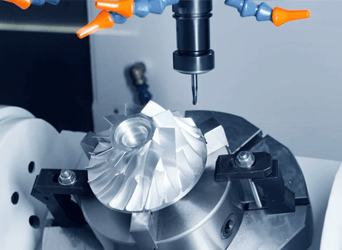
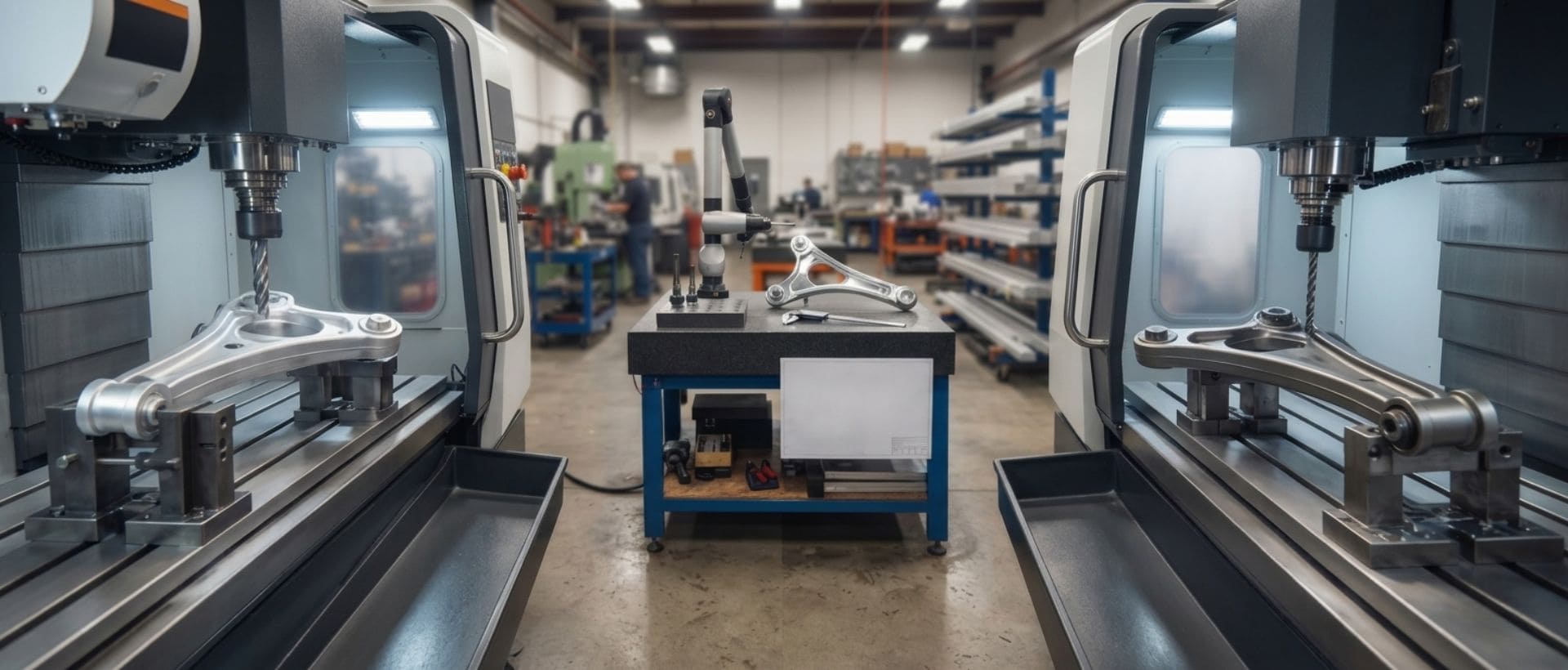
We machine cold plates to drawing for EV and power electronics programs; these are the trade-offs we discuss before an RFQ. For the parts themselves, see our custom liquid cold plate manufacturing.
A cold plate is a metal plate with internal coolant passages. A power module, cell stack or controller sits on its flat face; heat crosses the thermal interface material (TIM), conducts through the metal to the channel walls, and the flowing coolant takes it away by convection. “Cold” describes the plate’s job, not refrigeration.
An air-cooled heat sink does the same job with fins and airflow. Liquid takes over when the heat flux is high, the footprint is small or the enclosure is sealed: inverters, onboard chargers, DC-DC converters and battery modules.
A copper or stainless steel tube is bent to the flow path and pressed or bonded into grooves in an aluminum base, then the face is machined flat: the lowest-cost route for moderate heat loads. The weak point is the contact between tube and base, which adds thermal resistance.
Straight passages are drilled through a solid plate, cross-drilled where they meet, and plugged at the ends. There is no lid joint on the face, so the plate is robust and simple to qualify. Channel geometry is limited to straight lines and the wetted area is small, so it suits low heat flux.
The channels are milled into the base as a pocket, then closed by a lid. The lid can be sealed with an O-ring and fasteners, or joined by friction stir welding (FSW): a solid-state process with no filler and low distortion, described in ISO 25239. The channel layout is free, so channels can follow the heat sources, and design changes only mean a new program.
In this industry process, layers of clad brazing sheet (3003 core with 4004 or 4104 cladding), fins and turbulators are stacked and brazed in a vacuum furnace. All internal surfaces join in one cycle without flux, which allows the most complex internal structures and multi-layer plates. Fixtures and furnace qualification add cost that only pays off once the design is frozen.
Skived or folded fins, pin fins and microchannels multiply the wetted surface under concentrated heat sources such as IGBT or SiC power modules. The price is a higher pressure drop and more sensitivity to contamination in the coolant.
| Construction | Thermal performance | Pressure drop | Tooling / NRE |
| Press-in tube | Moderate | Low to medium | Low (bending tools) |
| Gun-drilled channels | Low to moderate | Medium | Very low |
| Milled channels and lid | Good | Medium | Low (program and fixture) |
| Microchannel or fins | Highest locally | High | Medium to high |
Vacuum brazed plates, as the industry builds them, give very high thermal performance with medium to high pressure drop, but high tooling cost (fixtures, furnace), so they suit frozen designs and larger batches. Design freedom runs from tube bends (press-in tube) and straight paths only (gun-drilled) to high for milled channels and fin designs, and very high, multi-layer for brazed plates. Press-in tubes fit any volume where cost drives the choice, gun-drilled plates low to medium volumes, milled channels engineering samples to repeat batches, and microchannel or fin designs power modules.
| Material | Thermal conductivity | Density | Corrosion and cost |
| Aluminum 6061 / 6063 | About 150 to 200 W/m·K | Low | Default for automotive plates; anodizing possible |
| Copper C101 / C110 | About 390 W/m·K | About 3.3 times aluminum | Best for concentrated heat; heavier and more expensive |
| Stainless 304 / 316 tube | About 15 W/m·K | High | Used as tube for aggressive coolants |
Aluminum 3003 brazing sheet (about 160 W/m·K, low density) is used in vacuum-brazed layers. Machinability is very good for aluminum 6061 / 6063, good for 3003 brazing sheet, slower for copper and hard for stainless tube.
Aluminum is the default for vehicle plates because weight matters and a good channel design makes up for its lower conductivity; see aluminum automotive components. Copper earns its place under small, very hot sources.
Keep the wetted metals consistent. An aluminum plate in a loop with copper tubing or a copper radiator forms a galvanic couple through the coolant, and the aluminum corrodes until it leaks. Most loops run water and ethylene glycol (WEG, often 50/50) or water and propylene glycol, with inhibitors; some power electronics use dielectric fluids. Check the O-ring and gasket materials against the fluid too.
A serpentine path sends all the coolant through one long channel: even velocity, but high pressure drop, and the coolant warms along the way, so the last heat source runs hotter. A parallel layout splits the flow through several channels fed by a manifold: pressure drop is low, but the manifold must be balanced or some branches starve.
Large plates such as battery cooling plates often use split-flow manifolds; local fin or pin zones go where heat is concentrated. The layout comes from your CFD and thermal simulation; the manufacturer checks that it can be machined and inspected.
| Situation | Construction to start with |
| Low heat flux, tight budget, simple layout | Gun-drilled channels or press-in tube |
| Moderate to high heat flux, design still changing | Milled channels with an O-ring lid |
| Concentrated hot spots on part of the plate | Local fin or pin zones in a milled body |
In industry practice, a frozen design where a sealing joint is preferred moves to milled channels with an FSW lid; very high heat flux with complex internal fins and stable volume points to a vacuum brazed plate with fins or microchannels, and local fin or pin zones can also sit in a brazed body.
A cheaper construction is often enough: if a drilled or tubed plate meets the thermal target with margin, brazing is not worth paying for.
We integrate advanced machining, specialized materials, and surface finishing to deliver mission-critical parts that meet every rigorous automotive standard.
Fill out the form below and our team will get back to you promptly with a personalized quote tailored to your needs.